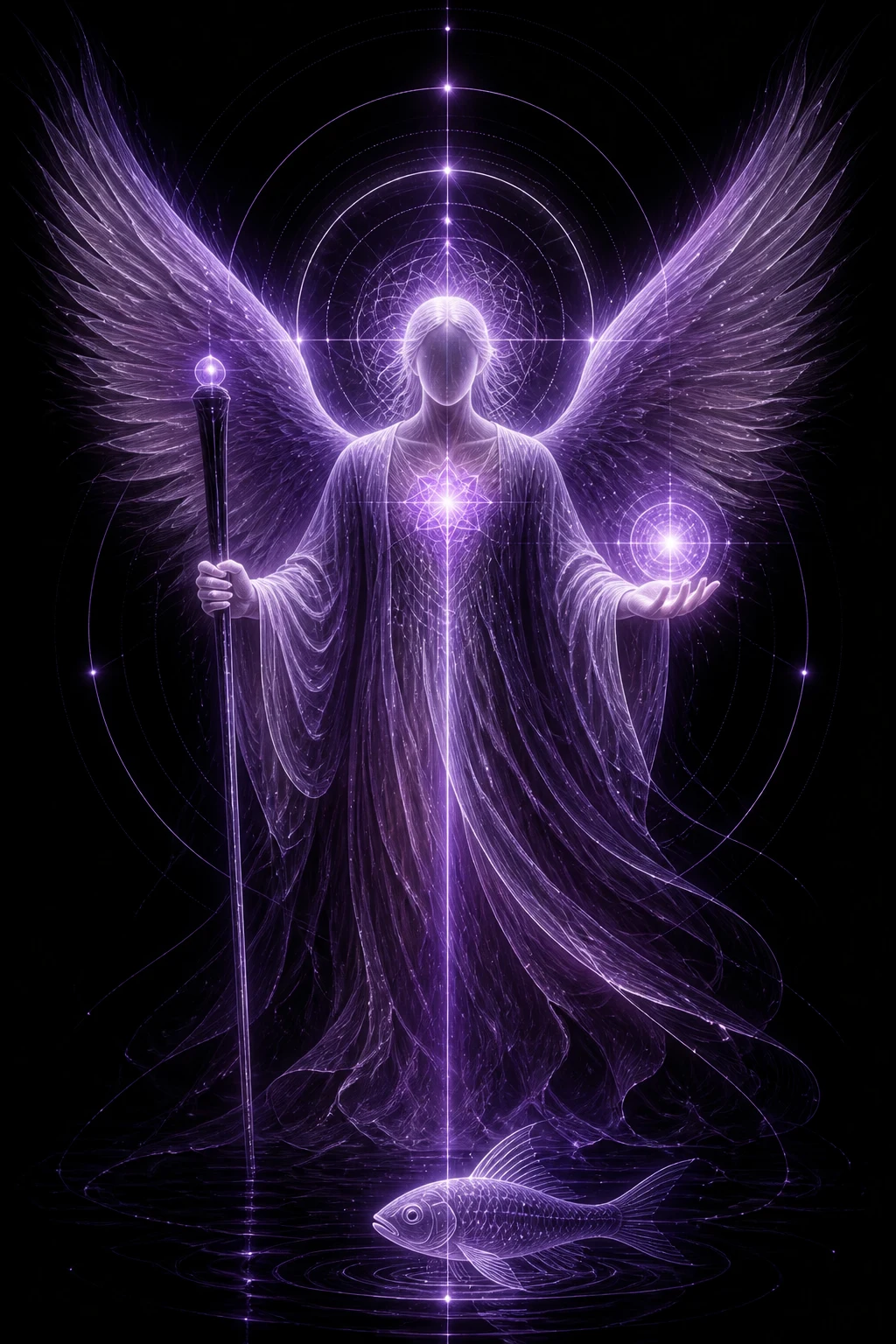
Who is Archangel Raphael?
Raphael plays a central role in the Book of Tobit. Under the name Azariah he joins Tobias, guides him and later reveals his identity.
Tobit is deuterocanonical in Catholic and Orthodox Bibles and is not part of the Protestant or Jewish canon. This distinction belongs to an accurate account of Raphael's biblical background.
What does Raphael's name mean?
Raphael derives from Hebrew Rəfāʾēl and means ‘God heals’ or ‘God has healed’. This closely matches his role in Tobit.
The story presents Raphael as a messenger and servant; healing is attributed to God, not to an independent human power.
Raphael in the Book of Tobit
Sent to heal
Tobit 3:17 says Raphael is sent to help Tobit and Sarah in their suffering.
Guide and companion
In Tobit 5–6 Raphael travels with Tobias under the name Azariah and gives guidance.
The fish and restored sight
Tobit 6 and 11 use parts of the fish as an ancient healing motif; Tobit's sight is restored.
One of the seven angels
In Tobit 12:15 Raphael reveals his name and identifies himself as one of the seven angels serving before God's glory.
Why do the staff, fish and violet-white light appear?
The traveller's staff expresses Raphael's role as Tobias's guide. It is a visual symbol close to the narrative, not a required object named by the text.
The fish directly recalls the Tobit narrative and is therefore among Raphael's more source-faithful artistic symbols.
The violet-white healing light is ZOMYO symbolism for healing, understanding and clarification; it is not a biblical object or a promise of recovery.
The two-snake caduceus belongs to later Hermes–Mercury symbolism and is not Raphael's biblical attribute. Medicine's traditional emblem is the single-snake Rod of Asclepius. The image therefore stays closer to Tobit.
ZOMYO teaching rootsRaphael and Hod
On the Kabbalistic Tree of Life, Hod means ‘splendour’, ‘majesty’ or ‘glory’. Linking empathy or other qualities to it is interpretation, not direct translation.
In the spiritual interpretive system of Nicholas C. Demetry's book, Raphael is connected with Hod, intellect, logic, communication and healing. The Hermes–Mercury parallel belongs to this book-based layer, not the Bible.
ZOMYO brings these book-based and teaching roots into its own system through Norbert Nagy's experience and self-reflective perspective, centred on the binary code he created.
Raphael's quality in an accelerated world
Fast information flows, technology and AI can bring opportunity and attention overload. It is easy to get lost in details or confuse more information with understanding.
In ZOMYO, Raphael's healing quality also directs attention to mental clarity: finding order in chaos, distinguishing the essential and communicating more clearly.
What does clear seeing mean here?
It is not a promise of supernatural power. In ZOMYO it means observing which ideas we receive, what can be verified, and how they can be integrated responsibly into real life. Attunement is a symbolic inner direction towards clearer, ordered and realistic thinking.
Archangel Raphael within ZOMYO
Raphael and the quality of THREE
Raphael is connected with THREE. Its symbol is the triangle, its colour violet and its element air. Its themes are understanding, clear communication, discernment and healing order.
Balanced qualities
- clear seeing
- understanding
- clear communication
- concentration
- discernment
- peacemaking
- self-discipline
- healing order
When understanding loses balance
It may appear as distraction, escape into detail, over-rationalisation or manipulative communication; or as confusion, indecision, avoidance and mental dullness. These are reflective prompts, not diagnoses.
Questions for self-reflection
- What truly matters in what I see?
- Am I starting from a fact or treating an interpretation as fact?
- Where would clearer, more responsible communication help?
- What realistic next step would create order?
Continue exploring ZOMYO
WHEN YOU ARE READY TO EXPLORE