SHADOW WORK · SELF-REFLECTION GUIDE
What is shadow work? Meaning, process and 16 self-reflection questions
Shadow work is not about seeing ourselves as bad. It helps us recognise feelings, reactions and recurring patterns that are difficult to accept. Why do we resist this, and how can we begin to work with it honestly?
What is shadow work?
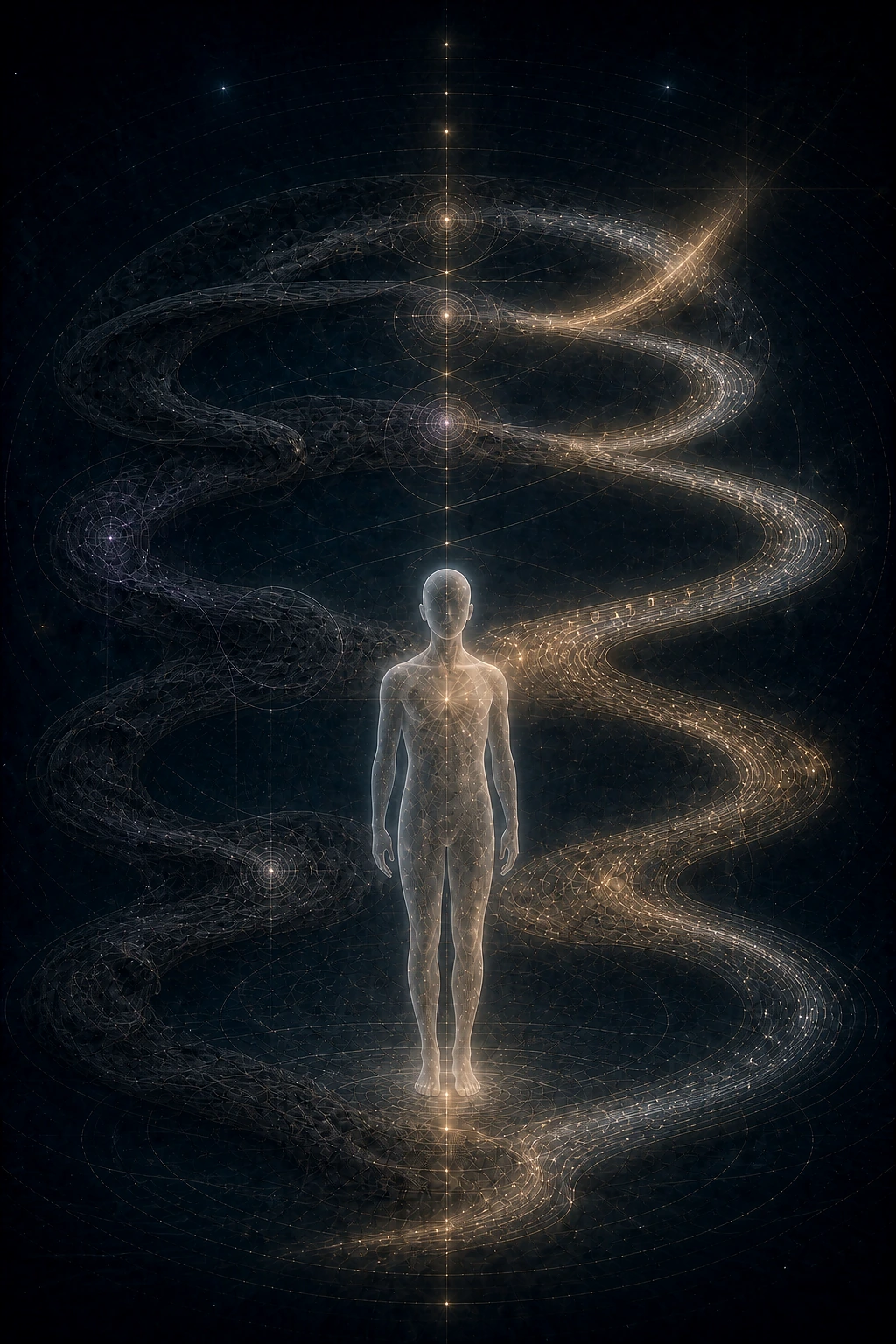
Some qualities, feelings and reactions are easy to acknowledge. Others — such as anger, envy, resentment, shame, excessive control or the need to please — can be harder to face.
Shadow work means recognising and consciously examining these less visible inner patterns. We look at them not to condemn ourselves, but to understand what drives our reactions, what we repeat and where a more conscious response may become possible.
What does the shadow mean?
The term ‘shadow’ is associated with Carl Gustav Jung’s analytical psychology. In simple terms, it refers to parts of our personality and inner material that are difficult to reconcile with the image we hold of ourselves.
The shadow need not contain only negative qualities. Strength, assertiveness, creativity or sensitivity may also be pushed aside when they once felt unacceptable or unsafe to express. The shadow is not an enemy within us, but an area we do not yet see clearly or know how to handle consciously.
How can our shadow side develop?
We continually learn what we may show of ourselves. We may have learned that anger is forbidden, that we must always be strong, that crying is weakness, assertiveness is selfish, mistakes are shameful, or love depends on pleasing others.
A rejected feeling or need does not necessarily disappear. It may later appear indirectly as sudden anger, resentment, over-adaptation, control, procrastination or recurring relationship situations. This does not mean every strong reaction has the same cause: shadow work offers questions, not ready-made explanations.
Why is shadow work often misunderstood?
It is often presented as if a few questions could quickly remove every difficult pattern. Recognition matters, but it is not always enough on its own.
Shadow work is better understood as recurring attention: noticing the reaction, pausing, observing the feeling, exploring what lies behind it, taking responsibility for our part, and then finding and practising a more conscious response.
Shadow work is not about removing negative feelings
Anger, fear, sadness or jealousy do not change simply because we call them bad, suppress them or replace them quickly with a positive thought. They may point to a crossed boundary, helplessness, fear or another need, but that does not make every action arising from them acceptable.
Recognising a feeling and taking responsibility for behaviour are both important. I can understand why I reacted as I did while still deciding that I want to act differently next time.
Why do we resist recognising our shadow side?
It may be easier to look only at our positive qualities. We may fear that seeing our more difficult parts would make us a bad person, or that recognition would require us to change our behaviour, relationships or boundaries.
Resistance may involve shame, protecting our self-image, blaming others, fear of change, or a pattern that once offered genuine protection. We can observe resistance without condemning ourselves again.
Why does a quick ‘rewrite’ not always work?
We often want to overwrite an uncomfortable, partly unconscious pattern immediately with positive thinking. Positive thoughts can support us, but they do not replace understanding when a reaction appears, what strengthens it and which fear or need it covers.
Transformation is not merely overwriting. First we come into contact with what we want to change: we recognise it, name it and observe how it works. Then we can choose a different action.
When the people change but the situation repeats
We may leave a difficult romantic relationship or friendship and later find familiar feelings and roles returning with different people. We may again fear abandonment, struggle to set boundaries or adapt too much. The opposite can also happen: we may truly want to be alone, yet enter another relationship because we believe we need someone else in order to grow or feel complete. Shadow work can also help us recognise that we are capable of developing on our own.
It can feel as though the actors have changed while the stage remains the same. This does not mean we alone are responsible for every relationship or that we ‘attracted’ another person’s harmful behaviour. Everyone is responsible for their own actions, and safety always comes first in abusive or dangerous situations.
When the same feelings and reactions return across relationships, it can be worthwhile to examine our own inner pattern as well — not to blame ourselves for everything, but to see what we can genuinely change.
When desire and conscious connection point in different directions
Sexual desire and physical attraction can be a natural part of a relationship. They are not qualities of light or shadow in themselves. They can become important areas for self-reflection when, alongside strong attraction, we repeatedly find that we cannot connect with the other person in our values, boundaries, direction in life or intention to grow.
We may know that a relationship does not serve us in the longer term and still find it difficult to leave because desire, sexual attraction or the intensity we experience together affects us more strongly than what we have already recognised consciously. The aim is not to call desire bad, but to examine the role it has in our life, what it sustains and what we do not want to see beside it.
In ZOMYO's interpretive language, our desires can also nourish elementals. A desire elemental may be strengthened by our attention, fantasies, repeated choices and repeated return to the same experience. This can sustain dependency as well as different forms of addiction connected to a person, a sexual experience or another recurring experience. This is a holistic interpretive layer, not a psychological diagnosis or a generally accepted scientific definition.
We can ask ourselves honestly: Am I connecting with the other person, or mainly with the feeling I experience beside them? Can we build something together beyond attraction? Am I choosing this relationship freely, or is a recurring desire keeping me in it? What do I already know consciously that I am not yet following in my decisions because of desire?
What can shadow work offer?
It may help us recognise recurring emotional reactions, notice what we reject in ourselves and others, see our responsibility more clearly, form more conscious boundaries and respond less automatically.
It does not promise that every difficulty will disappear. The aim is not perfection, but earlier recognition and a wider choice in how we respond.
Shadow work within ZOMYO
ZOMYO is an independent system of self-reflection created by Norbert Nagy, with the binary code as its original central element. Within ZOMYO, light and shadow qualities are not simply good and bad traits: the same underlying quality may appear in a balanced, excessive or depleted form.
In ZOMYO’s interpretive language, recurring patterns of thought and emotion are connected with elementals. Patterns carrying fear, anger, dependency, shame or other draining expressions may be called negative or shadow elementals. ZOMYO treats shadow elementals as a holistic interpretive layer, not as a psychological diagnosis or a generally accepted scientific definition.
What does transformation mean within ZOMYO?
Transformation does not mean denying a difficult feeling. We first recognise when it appears, what feeds it and how it affects our choices. Then we look for a clearer expression of the same underlying force.
The force behind anger may become boundary-setting; excessive control rooted in fear may develop into preparation and responsibility; people-pleasing may give way to honest connection. Recognition needs to be followed by repeated choices and new actions.
First set: how can I recognise my own shadow side?
Do not try to answer everything at once. Choose the question that genuinely speaks to you and write down what arises without judgement.
1. Which situations repeatedly trigger a disproportionately strong reaction in me?
Choose one specific recurring situation and first observe when and how the reaction appears.
2. What happened immediately before this reaction appeared?
Separate the actual event from what you assumed about it in that moment.
3. What do I feel beneath the surface anger, hurt or indifference?
Do not search for the correct answer; name the feeling that is truly present.
4. Which quality particularly disturbs me in others, and can any form of it be found in me?
The similarity may not be literal. The same quality may appear in you in a very different form.
5. What recurring story do I tell myself in these situations?
Notice inner statements involving ‘always’, ‘never’, ‘everyone’ or ‘I have to’.
6. What am I trying to hide, protect or prove through my reaction?
A more vulnerable feeling, boundary or old defence may lie beneath it.
7. What consequences does this pattern have for me and for those around me?
Consider both the short- and long-term effects: what does the pattern give you, and what does it take away?
8. In what more conscious and constructive quality could the same inner force appear?
Do not seek to erase the feeling; seek a response that holds both strength and responsibility.
Second set: why do I resist working with it?
This section explores not only the shadow side, but also our resistance to meeting it.
9. What am I afraid of if I honestly recognise this part of myself?
Notice which consequence, loss or change you fear.
10. Do I fear that a difficult feeling or reaction makes me a bad person?
Recognising a feeling is not the same as approving every action that may arise from it.
11. Which quality, feeling or desire in myself do I feel ashamed of?
Try to name it without immediately explaining or rejecting it.
12. Do I quickly cover with positive thinking what I first need to understand?
Consider whether you allow time to understand the difficult feeling before trying to change it.
13. Whom or what do I blame for something that is difficult to recognise within myself?
The other person’s responsibility and the examination of your own pattern can both be present.
14. What might this pattern once have protected me from, and do I still need the same protection?
An old pattern may once have helped you while limiting you today.
15. What do I gain by not beginning to work with it?
Resistance can have a short-term benefit, such as avoiding a painful recognition or difficult decision.
16. What is one honest and realistic step I can take now?
Choose a small, specific step that you can practise, not merely imagine.
How to work with the questions
Your answers do not need to sound polished. Write what is genuinely present. If you cannot answer a question, note that too and return to it later.
Begin with one concrete situation: What happened? What did I think? What did I feel? What did I do? What was I trying to protect? What could I do differently next time? Shadow work is not a competition, but honest and consistent attention.
An important boundary
Self-reflection does not replace psychotherapy, medical care or other professional support. If a question brings up severe anxiety, traumatic memories, thoughts of self-harm or an emotional state that feels unmanageable, do not force yourself to continue. Stop, make your surroundings safe and seek appropriate professional help.
You do not have to work with every inner experience alone.
The aim is not to eliminate the shadow
Shadow work is not about becoming an exclusively positive person. It is about seeing more clearly what operates within us, what we feed with our attention and what choice we make when the same situation appears again.
What we refuse to see may still affect us. What we recognise can be met more consciously. ZOMYO offers no final judgement here, but a mirror and questions.
ZOMYO · JOURNAL
Would you like to save this practice?
Save the questions to My Journal. You can write your own answer below each question and return to them whenever you wish.
The entry and your answers remain on this device. ZOMYO does not send them to a server.